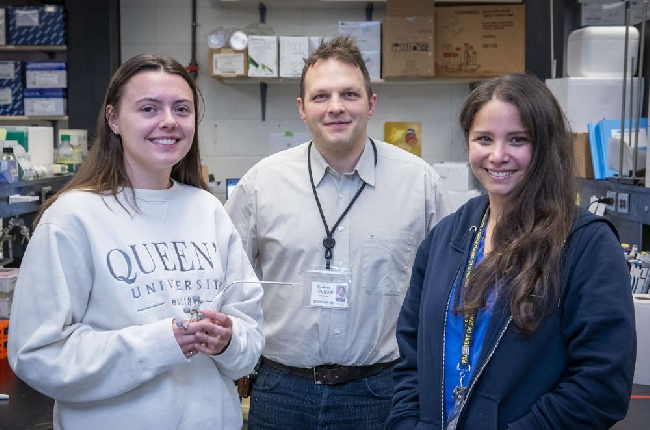
World-first 3D-printed biopsy capsule developed in Kingston could transform glioblastoma research and treatment.
A Canadian research team has developed a world-first 3D-printed surgical biopsy tool that could change how scientists study glioblastoma, the most aggressive form of brain cancer.
Neurosurgeon Dr. James Purzner gives us an idea of what glioblastoma is.
The innovation, created by neurosurgeon-scientists Dr. James Purzner and Dr. Teresa Purzner at Kingston Health Sciences Centre and Queen’s University, along with Queen’s engineering PhD candidate Kaytlin Andrews, was recently published in Operative Neurosurgery. The patented capsule allows surgeons to collect tumour tissue with unprecedented accuracy during operations.
Purzner explains that this tool is a 3D printed device.
Researchers say the tool could transform how brain tumours are understood and eventually treated. The capsule lets teams gather dozens of tissue samples and link each one to MRI imaging, creating a detailed map of a tumour’s molecular makeup.
With the new approach already in use in Kingston operating rooms, KHSC is currently the only centre in the world using the device.
The team says the technology may support more targeted radiation, safer surgical planning and new drug development. Each capsule costs about 30 cents to produce using standard 3D printing.
Dr. Purzner stresses that right now they are in the testing faze of this development.
KHSC and Queen’s are now partnering with hospitals across Ontario and preparing to build a national tissue bank, positioning Kingston as a growing hub for brain tumour research.
Story by Alyssa Brush
 Wright, Kulemin lead Frontenacs in win over Bulldogs
 Jeff Code brings his iconic Sunday country show to New Country 98.9
 Kingston residents invited to cram a cruiser this weekend
 Kingston post-secondary institutions to continue to see drop in the number of international students
 "Maplewash" Canadian word of the year according to Queen's University